Expert Advice on Creating Your Perfect CV

A good CV is an absolute essential for any job hunter. In today’s fiercely competitive job market, your CV (and the covering letter that accompanies it) can be one of the most important factors in determining whether or not you find employment.

At GreatCVs, we recognise the importance of your CV, but we also understand that many people are daunted by the prospect of writing one. The site is here to guide you through the process with a mix of guides, tips, and free ebooks.

1. Where should I begin?

For many people, simply putting pen to paper is the most difficult part of writing a CV. We have compiled some CV starting points to help you get over the first hurdles, and make sure that you familiarise yourself with the most common CV mistakes before you begin!

2. Which CV style should I choose?

Don't make the assumption that there is a ‘one-size-fits-all’ CV style. Rather, there is a broad range of CV styles, and your choice will depend on a number of factors, including the job you are applying for and your personal background.

The chronological CV is the most commonly used, but this may not be the best choice for you. Instead, you may choose to highlight your expertise with a skills-based CV, or even a functional CV. Alternatively, you might choose a combination CV, which can help you to take the most relevant elements from each option and create something that is right for the application at hand.

3. What about freelancers?

Freelancers are faced with a unique set of problems when applying for jobs. Clearly, the conventional chronological CV and references tend not to be applicable for those applying for freelance positions. Instead, you may consider using a version of the skills-based format to help highlight why you are the right person for the job. GreatCVs has compiled a guide to freelance CVs to help you get started.

4. My CV has gaps. What should I do?

This is a common problem, and one which can make life difficult for job applicants. If you have been in and out of work, for example, because you started a family or because you were made redundant, you may well be wondering how to patch up the resultant gaps.

We have put together tips to help you explain gaps in employment, apparent lack of experience for a position, or a lack of formal qualification like a degree. Given the recent state of the jobs market, you may also be interested in our tips for those who have recently lost their job.

5. When should I update my CV?

It is important that you always keep your CV up to date. It cannot be an effective reflection of your skills and talents unless it includes your most recent achievements. Make sure that you keep the document current by adding in new positions and new experience as you gain them – rather than scrambling to write it at the last minute.

6. What about references?

References are among the most important elements of your CV. They help to ensure that your claims are taken seriously, and they give potential employers the ability to check your background. But references also pose some problems for those writing their CV.

First of all, you may be wondering who to pick as your referees. Generally, you should go with previous employers who operate in a similar area to your prospective new employer – and, crucially, who are likely to give you a good report! You may also, however, have a specific problem that is making it difficult for you to think of a reference. We have compiled a list of common difficulties, with some ways to navigate them.

7. Do I need a covering letter?

Absolutely! A good covering letter is a vital part of any job application. In fact, some employers would suggest that it is as important as the CV itself. Your covering letter is the first impression that you will make on a potential employer, and it is vital that you get it right.

We have compiled some top tips to help you write a covering letter that will get you noticed, along with some general guidance on writing a great opener. If you are still unconvinced about their use, GreatCVs also explains exactly why your cover letter is important.

8. Should I pay someone to write my CV for me?

Given the importance of your CV, and the degree of difficulty that it causes some job applicants, it is unsurprising that some people consider hiring a professional to help them write their CV.

If you are considering employing a professional, you should make sure that you take some time to find a reputable CV writing service. You should ask them some key questions before beginning in order to make sure they are a good fit.

On the other hand, you might be considering setting up your own CV writing service. We have put together a quick-start guide to help you take your first steps in the business, along with a rundown of the credentials you will need.

9. How should I start job hunting?

Once you have a CV you’re happy with, your job hunting can begin. This is, of course, rather more complicated than it sounds. GreatCVs isn’t just here to help you write your CV – it is also here to help you use that document to find a job. So, we have put together a basic guide to the different methods of job hunting you might employ, along with some tips for organising your job search. We have also compiled some tips to help you discreetly look for a job while employed, along with hints for those who are out of work.

Many people consider using an employment agency to help them on their way. While this can be a good option for some, you should make sure that you understand the deal in advance – and that you are aware of the potential disadvantages.

10. What about internships?

Internships have risen to prominence again, following a number of campaigns to see the laws surrounding these arrangements tightened up. Many people consider internships to be the only realistic way to get into the world of work, particularly if you want to get a job in the creative industries. But it is important to understand that they can, in fact, exist in something of a legal grey area.

If you are considering interning first, you should make sure that you go for an internship that will actually benefit you and your career, rather than one that will see you making tea for month. More importantly, though, you should understand their legal treatment, and be ready to challenge an employer who regards you as an unpaid employee.

11. I’ve got an interview! Now what?

First of all, congratulations! Now for the nerve-racking part. Many people dread job interviews. If you are one of them, you may wish to read our article on handling interview nerves. You should also familiarise yourself with some of the general questions that may be asked, and check out our biggest interview mistakes – just to make sure you avoid a howler.

It is also worth noting that many employers are using new, high-tech recruitment solutions. In practice, this means that you might be expected to conduct an online aptitude test before you even get to the office. You may also have to carry out a psychometric assessment, either before or during your interview.

You may also find that you are asked to conduct a telephone interview before your face-to-face meeting. This is particularly common in large organisations, and it requires a different technique. You may find it helpful to read our telephone interview tips to get you on track.

12. How do I negotiate with a potential employer?

Once you have completed your interview and you have been offered a position, the negotiations can begin. From the outset, you should remember that you are not obliged to simply take the first offer that comes your way. Remember that you are of value to an employer – and the terms of your contract should reflect that.

You should therefore be prepared to negotiate on salary in order to get what you deserve. Make sure that you understand employee benefits, and how these affect your total remuneration package. Finally, if this is your first job negotiation, you should familiarise yourself with the negotiation basics before you begin.

Writing your CV and applying for jobs can be a long process, but GreatCVs is here to help you through it, from the very first stages right through to taking up your new position. Good luck!

Popular Articles...
Hobbies and Interests On a CV
HOBBIES AND INTERESTS ON A CV: Most CVs will have a section in which candidates can state their hobbies and interests away from the...
A CV for a Teenager
A CV FOR A TEENAGER: The summer is approaching and you have just finished your GCSEs. You hope you will be successful, and will attend...
CV Words and Phrases
CV WORDS AND PHRASES: Though every résumé or curriculum vitae (CV) is unique, many use similar words and phrases to grab the attention of...
Our Categories...
Ask Our Experts
Ask Our Experts: How Can I Make My CV More Presentable?, My Graduate CV: How Can I...

Case Studies
Case Studies: What Businesses Look for in a CV: A Case Study, My Return to Work...

Cover Letters
Cover Letters: How to Write a Cover Letter to Get You Noticed, Job Advert Cover...
CV Considerations
CV Considerations: Resume versus Curriculum Vitae, Hobbies and Interests On a CV, How...

CV Starting Points
CV Starting Points: Take Our CV Questionnaire, The Most Common CV Mistakes, Do Employers...

CV Styles
CV Styles: How Are Freelance CVs Different?, Writing A Chronological CV, Tailor...
CV Writing Services
CV Writing Services: CV Writing Services Organisations, Finding a...

Finance
Finance: National Minimum Wage, Employment Tax Issues, Working Tax Credits,...
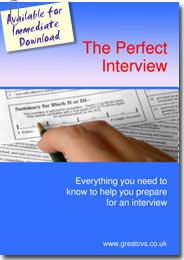
Free Downloads
Free Downloads: The Ten Step Interview Guide (Free Download), The Perfect Sales &...
Interviews
Interviews: Online Aptitude Tests, Tips for a Telephone Interview, Playing an...

Job Hunting
Job Hunting: Should I Intern First?, Writing a Resignation Letter, Looking for a...

Job Negotiations
Job Negotiations: Getting What You Deserve: Negotiating Your Salary, Negotiation for...

Legal Issues
Legal Issues: Your Employment Contract, Dealing With Unfair Dismissal, Grievance...

Specific CVs
Specific CVs: A CV for a Teenager, Creative Writing CV, Writing Your First CV,...
Our Quick Links...
Most Popular...
Add to my Yahoo!
Add to Google
Stumble this
Add to Twitter
Add To Facebook
RSS feed
You should seek independent professional advice before acting upon any information on the GreatCVs website. Please read our Disclaimer.